
New Paper Accepted at AMIA 2026: CEDAR + AI for Automated Metadata Standardization
We’re pleased to share that a new paper from the CEDAR team has been accepted for presentation at the 2026 AMIA Annual Symposium: “Automated Standardization of Legacy Biomedical Metadata Using an Ontology-Constrained LLM Agent.”
CEDAR’s core idea is that community metadata standards should be machine-actionable—encoded as templates that specify not just which fields are required, but exactly which values are allowed, drawn from controlled vocabularies and ontologies. This paper shows what becomes possible when those structured constraints are placed in the hands of an AI agent: messy, noncompliant legacy metadata can be cleaned up and standardized automatically, at scale.
The Problem: Millions of Messy Legacy Records
Public repositories are full of metadata authored before tools like CEDAR existed—idiosyncratic field names, free-text values, and inconsistent adherence to standards. That looseness is a fundamental barrier to FAIR data. Large language models can help interpret and rewrite such records, but on their own they don’t reliably produce the canonical terms a standard requires, and their training knowledge goes stale as ontologies evolve.
The Approach: CEDAR Constraints + a Tool-Using AI Agent
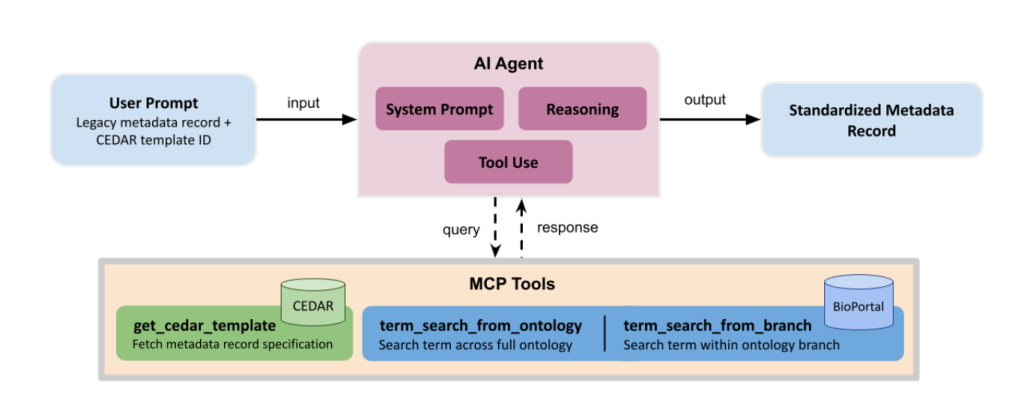
The paper presents ARMS (Agentic Real-Time Metadata Standardization), an LLM agent that treats CEDAR’s value constraints as executable specifications rather than static prompt text. Using tools exposed through the Model Context Protocol, the agent:
- Retrieves the full CEDAR template—field definitions, data types, and value constraints—on demand
- Queries the BioPortal terminology service in real time for candidate ontology terms that satisfy those constraints
- Reasons over the results to select the best match, flagging ambiguous cases for human review rather than guessing
The Result: Large, Reliable Accuracy Gains
Evaluated on 839 legacy metadata records from the Human BioMolecular Atlas Program (HuBMAP) against an expert-curated gold standard, giving the AI live access to CEDAR and BioPortal consistently outperformed the prompt-only model across every field category (paired Wilcoxon signed-rank test, p < 0.001). The largest gains came on ontology-constrained fields—a 70% relative improvement—exactly where a model relying on memorized knowledge tends to fail.
Why It Matters
The work shows that machine-actionable metadata standards are valuable not only for guiding human curators, but as the knowledge backbone for AI. Coupling CEDAR’s structured constraints with tool-using LLMs points to a practical, scalable path for retrospectively repairing the vast archive of legacy metadata—and making existing scientific datasets far more findable, interoperable, and reusable.
Learn More
📄 Read the preprint on arXiv: https://arxiv.org/abs/2604.08552. The paper will be presented at the 2026 AMIA Annual Symposium. Code and data are available on GitHub: github.com/musen-lab/metadata-standardization-agent.
