
New Paper in AI Magazine: Knowledge Engineering for Open Science
We’re pleased to announce the publication of a new paper in AI Magazine titled “Knowledge Engineering for Open Science: Building and Deploying Knowledge Bases for Metadata Standards.”
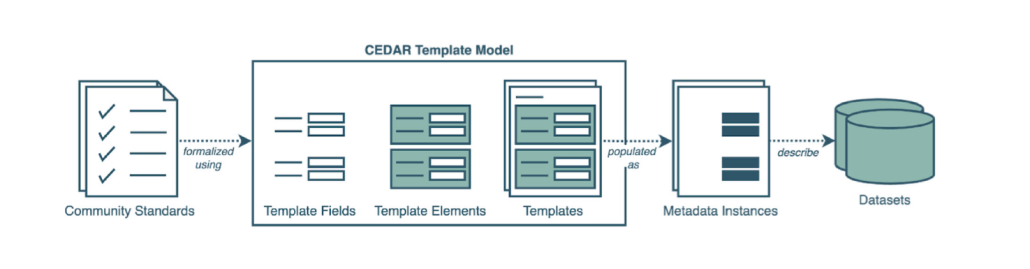
Synthesizing ten years of CEDAR research, the paper makes the case that the metadata templates at the heart of CEDAR are a modern form of declarative knowledge base—capturing, in symbolic form, how a community of scientists believes its data should be described so that datasets can be findable, accessible, interoperable, and reusable (FAIR).
The Big Idea: Metadata Standards as Knowledge Bases
Decades ago, hand-built knowledge bases powered intelligent systems by encoding expert knowledge in an inspectable, editable form. The paper argues that CEDAR templates play the same role for open science: they encode a community’s metadata reporting guidelines as machine-actionable templates that enumerate the attributes of an experiment and link those attributes to ontologies and value sets. Unlike patterns learned from data, these standards often don’t yet exist in any “learnable” form—so capturing them still requires the careful, expert-driven knowledge engineering the field has practiced for decades.
From Templates to Real-World Data Management
Because the knowledge lives in the template, a single CEDAR standard can drive many different tools. Uses described in the paper include:
- Web-form and spreadsheet-based metadata entry that shields researchers from the underlying complexity
- The CEDAR Embeddable Editor, which brings standards-based authoring directly into third-party platforms
- Validation and correction of existing metadata to bring it into line with a standard
- Templates adopted by scientific consortia such as HuBMAP, so deposited datasets are FAIR from the moment they are created
Why It Matters
As sponsors, publishers, and research communities increasingly demand FAIR data, the bottleneck is rarely technology—it is the absence of agreed, discipline-specific metadata standards. The paper argues that treating those standards as shared, declarative knowledge bases gives communities a transparent way to create them, agree on them, and deploy them across a range of intelligent systems, drawing on decades of knowledge-engineering experience to make FAIR metadata the default rather than the exception.
Learn More
? Read the full article in AI Magazine: https://doi.org/10.1002/aaai.70048.
